

How to Start a Business as a Teen in Canada
A step-by-step guide for 12 to 17 year olds: finding a problem worth solving, pricing it, getting a first customer, getting paid safely, and the few rules worth checking with a parent.
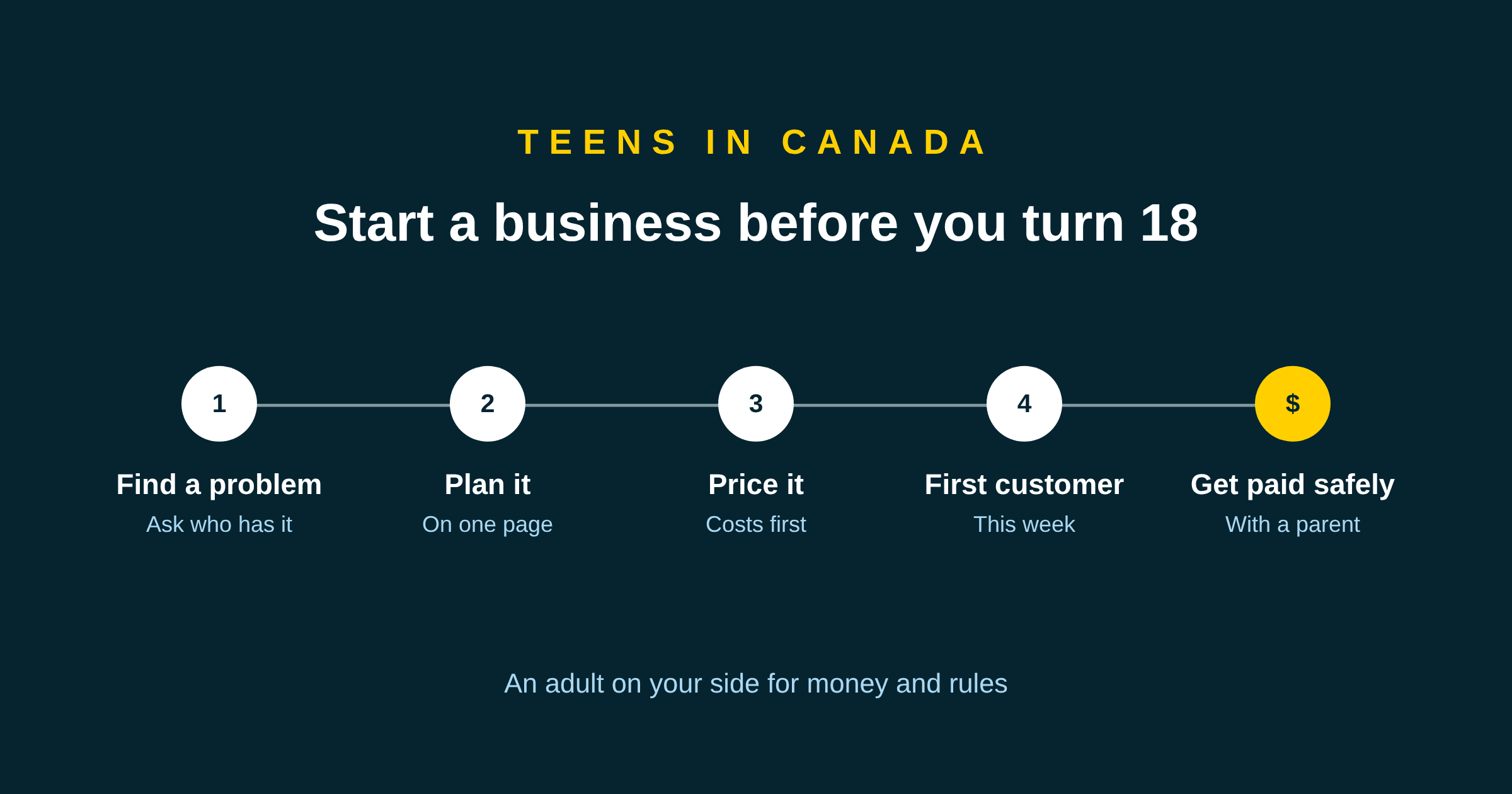
You do not need to be 18, have a company, or have a website to start a business in Canada. You need something people want, a fair price, one first customer, and an adult on your side for the parts that involve money and rules.
This guide walks through it in order. Each step is short, and each one links to somewhere you can go deeper.
1. Start with a problem, not a product
Most first businesses that fail start with "I want to sell X". Most that work start with "these people keep having this problem".
Look around for a week and write down small annoyances you notice. The neighbour whose driveway never gets shovelled before work. The younger kids on your street who struggle with fractions. The café that never has photos of its food online. Then ask two or three of the people who have the problem whether they would pay to have it solved. If they say "maybe", that is a no. If they ask when you can start, you have something.
Module 2 of the course is about exactly this: finding a problem and checking that someone other than you has it.
2. Pick an idea that fits your age and your town
Some ideas suit a 12 year old with a free Saturday. Some need a 15 year old who can take a bus across town. Some only make sense where it snows.
Our business ideas page groups ideas by the youngest age each one suits. Every idea page says what it costs to start, how to find a first customer, and which rules matter. Before you choose, check yours against a few questions: is it safe, is it allowed at your age where you live, can you start with what you have, does it fit around school, and does it make sense where you live?
3. Put the whole plan on one page
You do not need a 20-page business plan. You need one page that answers: who has the problem, what your answer is, why someone would choose you, how you will reach them, what it costs, and how you will know it is working.
A Lean Canvas does that in one sheet. Our Lean Canvas page has three filled-in examples from teenagers in the course, and a blank one you can print.
4. Work out your costs before your price
Write down everything the business needs, even small things: materials, transport, the poster you print. Then work out what one sale costs you.
Say you make bracelets. Beads and string for twenty bracelets cost $24, so each one costs you $1.20 in materials. If it takes fifteen minutes to make one, and you sell them for $5, you keep $3.80 for fifteen minutes of work. Is that worth it to you? Could you make them faster, or charge more for a custom colour? That is the whole of pricing at this stage.
Module 6 covers costs, revenue and budgeting in more detail.
5. Find your first customer this week
Do not wait until everything is perfect. Your first customer should be someone you already know: a neighbour, a relative, a teacher, a friend's parent. Tell them what you are offering, what it costs, and when you can do it.
Keep the first run small. One weekend, a handful of items, or three lawns. Afterwards, ask each customer one thing they liked and one thing you could do better. Then change one thing and go again.
6. Get paid safely
Money is where an adult needs to be involved, and that is a good thing rather than a limit.
- Cash in person is the simplest way for a young business to get paid.
- E-transfer to a parent's account works for people who do not carry cash. You keep a record of what is yours.
- Never give out card details, passwords or banking information, and do not open payment accounts in your own name without a parent.
- Do not share your own phone number or email with customers you do not know. Use a parent's, or a channel they control.
7. Check the rules with a parent
Most small projects for people you know need very little paperwork. A few things are worth checking together:
- Food. What you can bake at home and sell depends on your province, and school bake sales often have their own rules. The baking idea page explains what Ontario and BC allow.
- Working for strangers. Dog walking, babysitting or yard work for people you do not know needs an adult involved, and an adult present when you first meet.
- A business name. If you want to trade under a name other than your own, check with your province's business registry whether you need to register it.
- Sales tax. You do not have to register for GST/HST until your sales go over $30,000, either in a single calendar quarter or across four quarters in a row (Canada Revenue Agency, page modified June 2026).
- Income tax. Money from a business counts as income. For 2025 the federal basic personal amount was $16,129 (Canada Revenue Agency, page modified July 2026), which is roughly how much you can earn in a year before federal income tax applies. If your business grows well beyond pocket money, a parent should talk to an accountant.
None of this is legal advice. It is a list of what to look up.
8. Keep a record
Keep a page with three columns: money out, money in, and what it was for. Fill it in every time something happens. After a few weeks it will tell you which products sell, what your real costs are, and whether the business is worth your time. That record is also what you would need if you ever did have to report income.
9. Know when to stop or change
Ending a business, or changing it into something else, is a normal decision that real entrepreneurs make all the time. If it is taking over your week, making you stressed, or not selling after a few honest tries, stop and write down what you learned. The next idea will be better for it.
Where Hatchable fits
Hatchable is a course for students aged 12 and up that goes through these steps in order, from finding a problem to presenting a finished project. Modules 1 to 8 are published at /learn and you can read them without an account.
With an account, you also get somewhere to put the business: a one-page plan that builds up as you go, a pitch page family can back, and a simple shop where customers reserve what they want and pay you in person at pickup, so no card is ever entered. Parents can read For Parents for what we store and how the shop works, and our guide for parents covers how to help without taking over.