

A Fall Term Business Unit That Ends at a December Market
School is back and December is closer than it looks. A week-by-week plan for a student business unit that ends at a market before the winter break.
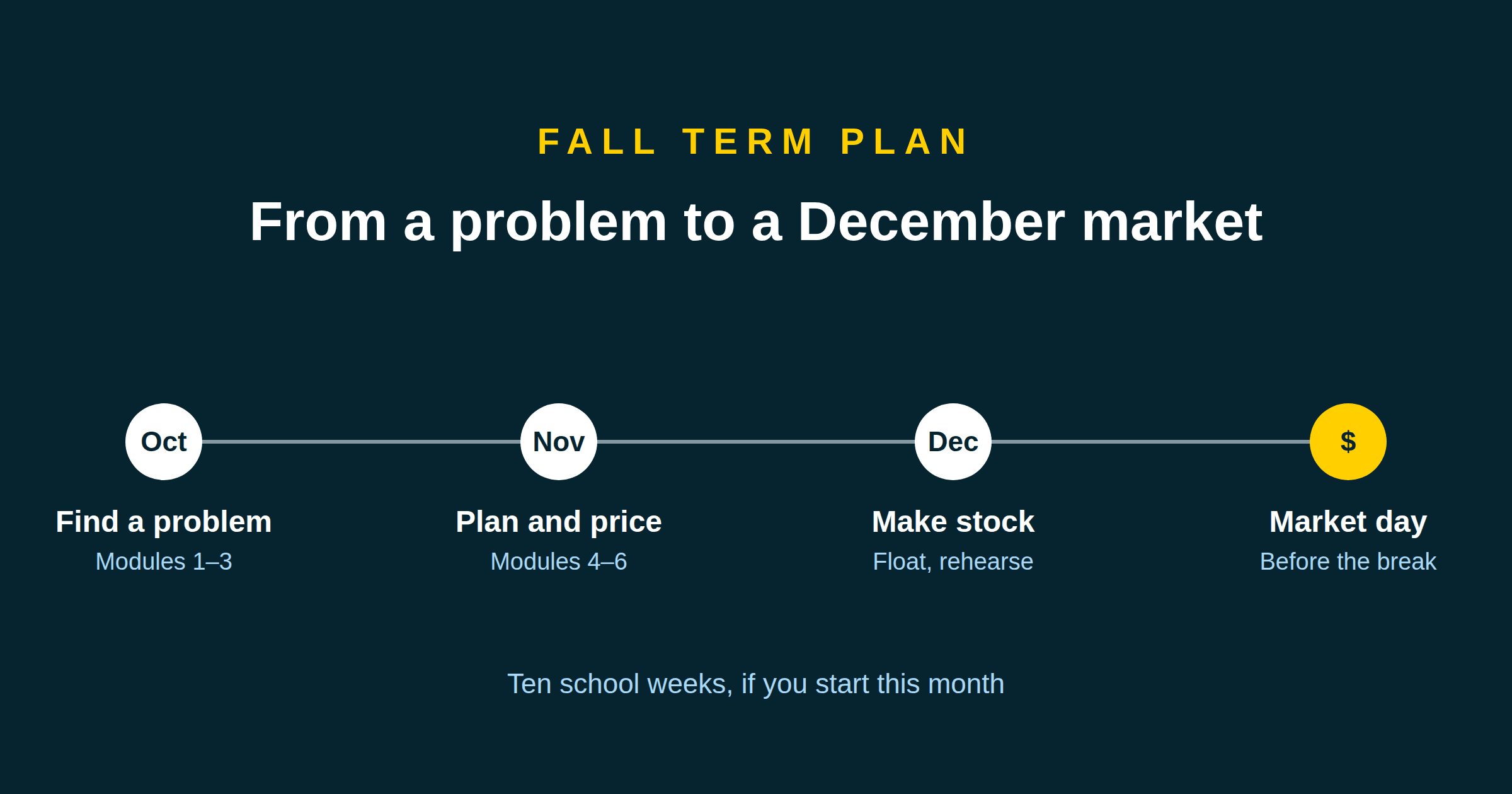
School went back in September, and the first weeks went where they always go: routines, names, seating plans, the gym schedule. By October there is room for a project, and the useful kind has a date at the end of it.
A December market is a good date. Students sell to real people. Families and the school community are already in a buying mood. And it lands before the winter break, so nothing trails into January half finished. From the first week of October to the middle of December is about ten school weeks, once you allow for Thanksgiving and your board's PA days. That is enough, if you start now.
This post is the plan we would give a teacher starting this month: why the fall works, what the research does and does not say, a week-by-week outline, and the rules to settle before anybody sells anything.
Why the fall is a good time
Three things line up between now and December.
The deadline is real. A market date that parents have on the calendar does more for a twelve-year-old's planning than any rubric. Work backward from it and every week has a job.
November is Financial Literacy Month. The Financial Consumer Agency of Canada has run it every November since 2011. The 2026 theme is "Talk Money", which the agency describes as encouraging purposeful conversations about money. In the plan below, the module about costs and pricing lands in November, so the two fit without forcing it.
Global Entrepreneurship Week runs November 16 to 22, 2026. It is a reasonable week to hold a short pitch session, with students explaining their idea to the class or to another class before they commit money to it.
What the research says, and what it does not
It is worth being honest here, because the evidence on school business programs is mixed, and the mixed parts are useful.
The strongest long-term study we know of followed Swedish students who had taken part in Junior Achievement's Company Program in high school, where students run a small company for a school year. Researchers compared them with similar students who had not, for up to sixteen years after graduation. The alumni were more likely to start a firm and earned more from running one. There was no effect on whether those firms survived.
A Dutch study of a similar student mini-company program found something less comfortable. Among college students, the program made no significant difference to how they rated their own entrepreneurial skills, and it lowered the share who said they intended to become entrepreneurs.
Read together, these do not cancel out. A student who runs a stall, works out what it costs, and decides that this is not for them has learned something real and probably saved themselves a mistake later. So we would judge a unit like this by what students can do and explain at the end, not by how many of them want to be founders.
Neither study looked at twelve-year-olds in Canada. Treat them as a direction, not a promise.
The plan, week by week
The outline below uses Modules 1 to 6 of the Hatchable course, which take a student from "what is entrepreneurship" to a priced product and a first sale. Plan by hand-ins rather than by videos. The videos are short and a group can watch several in one sitting, but each module ends in assignments, and a written assignment usually takes a class session on its own.
| Weeks | Roughly | Modules | What students leave with |
|---|---|---|---|
| 1 and 2 | Early to mid October | 1 and 2 | A problem worth solving, checked with people who actually have it |
| 3 and 4 | Late October | 3 | A solution they can test, and a decision between a product and a service |
| 5 and 6 | Early November | 4 | Market research, a one-sentence value proposition, a first Lean Canvas, and one idea they commit to |
| 7 and 8 | Mid November | 5 and 6 | How it reaches customers, what it costs, what it sells for, and the smallest version worth making |
| 9 | Early December | Making stock, setting a cash float, rehearsing the pitch at the table | |
| 10 | Mid December | The market |
A few notes on running it.
Weeks 1 and 2 are about problems, not products. Students who start with "I want to sell slime" tend to stay there. Module 2 sends them to talk to people before they decide anything, which is slower and works better. A student who is stuck can browse our list of business ideas for a starting point, then go and check whether anyone has the problem it solves.
Week 6 is the commitment point. After the Lean Canvas in Module 4, each student or team picks the idea they will carry to the market. Changing your mind after that point costs time you no longer have.
Weeks 7 and 8 are the money weeks. This is where Financial Literacy Month helps. One small assignment that fits the "Talk Money" theme: ask each student to talk to one adult at home about how they decide what something is worth paying for, and bring one sentence back to class. It makes the pricing lesson less abstract and costs nothing to run.
After the break, the market becomes the data. Modules 7 and 8 cover goals, metrics, measuring what a project changed and presenting the finished plan. A student who has just sold twenty-three bookmarks at three dollars each, against a plan of forty, has a far better January lesson than one working from guesses.
Five things to settle before anyone sells anything
1. Book the date with your principal now. December fills up with concerts and assemblies. Ask for the room and the time in October, not December.
2. Check the food rules before anyone plans a bake sale. In Ontario, Policy and Program Memorandum 150 says food and drink sold on school premises for school purposes has to meet the province's nutrition standards, and it names bake sales specifically. The way around it is a special-event day. The principal can designate up to ten of them in a school year, or fewer if the board sets a lower limit, after consulting the school council. Other provinces have their own school food rules, so ask before anyone plans around baking. Crafts, prints, small services and anything else that is not food avoid the question entirely.
3. Decide whose business it is. There are two honest ways to run this. Each student or team can run their own small business, or the class can run a sale on behalf of the school. If it is the school's sale, your board's procedures for handling money apply, and the office will know what they are. If it is the students' own, decide in advance who holds the cash box, who sets up the float, and how each team records what it sold.
4. Know where the tax line is, so nobody worries about it. Under the federal rules, a business is a small supplier if its taxable sales stay at or under $30,000 over four consecutive calendar quarters, and a small supplier does not have to register for or charge GST/HST. A student selling at one market is nowhere near that line. If the school is the seller, different rules can apply, and that is a question for your board rather than for this post. None of this is tax advice.
5. Cost it before you price it. Materials cost money before anything sells. Module 6 walks students through what their idea costs to run and what to charge, and the smallest workable version is usually the answer to "where does the money come from". A student who makes ten items and sells out has done better than one who makes fifty and sells twenty.
Where Hatchable fits
Modules 1 to 8 of the course are published at /learn, and anyone can read them. With a teacher account you can invite a class, see each student's progress lesson by lesson, read their hand-ins and leave feedback on each one, and open a teacher guide for every module. Students can also build a shop page for what they will sell. Customers reserve an item there and pay the student in person at pickup. No card is entered and no money passes through us.
One thing to know before you plan around it: we have not published a mapping between the course and any provincial curriculum document. If you report against specific expectations, that reading is currently yours to do.
If you want the longer version of how a class moves from idea to sale, the Hatchable Loop post covers it, and For Teachers covers the classroom side.
Sources
- Financial Literacy Month, Financial Consumer Agency of Canada, page modified August 27, 2026
- Global Entrepreneurship Week, Global Entrepreneurship Network
- Policy/Program Memorandum 150: School Food and Beverage Policy, Government of Ontario, updated December 18, 2024
- When to register for and start charging the GST/HST, Canada Revenue Agency, page modified June 16, 2026
- Elert, Andersson and Wennberg, The impact of entrepreneurship education in high school on long-term entrepreneurial performance, Journal of Economic Behavior and Organization, 2015
- Oosterbeek, van Praag and IJsselstein, The impact of entrepreneurship education on entrepreneurship skills and motivation, European Economic Review, 2010